Understanding the processes behind formación de nubes y lluvias is crucial, as solar heating drives air expansion and ascent, ultimately leading to precipitation.
Overview of the Topic
This exploration delves into the intricate relationship between atmospheric conditions and the development of clouds and subsequent rainfall. The sun’s energy initiates the process, warming the Earth’s surface unevenly, causing air to rise. As air ascends, it expands and cools, a fundamental step in cloud formation.
Water vapor condenses, forming droplets within clouds, and these droplets grow through collision and coalescence, or via the Bergeron process, eventually becoming heavy enough to fall as precipitation – rain, snow, or hail. Understanding these mechanisms is vital for predicting and managing water resources.
Importance of Understanding Cloud and Rain Formation
Grasping the formación de nubes y lluvias is paramount for numerous applications, ranging from agriculture and water management to weather forecasting and climate modeling. Accurate predictions of rainfall patterns are essential for optimizing crop yields, mitigating drought risks, and preparing for potential floods.
Furthermore, comprehending these processes aids in evaluating the effectiveness of cloud seeding programs, like those in Zacatecas and Aguascalientes, Mexico, and interpreting meteorological data from stations like Melilla in Uruguay.

The Water Cycle: A Foundation
The water cycle, driven by solar energy, initiates formación de nubes y lluvias through evaporation and subsequent condensation, a fundamental atmospheric process.
Evaporation and Transpiration
Solar radiation heats the Earth’s surface, causing water to evaporate – transitioning from liquid to gas. This warming occurs more rapidly at lower altitudes. Simultaneously, transpiration from plants releases water vapor into the atmosphere, contributing significantly to atmospheric moisture.
This combined process of evaporation and transpiration provides the essential water vapor needed for formación de nubes y lluvias. As air warms, it expands, becoming less dense and rising, carrying this moisture upwards, initiating the cloud formation process.
Condensation: The Key to Cloud Formation
As moist air rises and cools, water vapor undergoes condensation – changing from a gas to liquid. This process is fundamental to formación de nubes y lluvias. Condensation doesn’t happen spontaneously; it requires tiny particles called condensation nuclei.
These nuclei provide a surface for water vapor to condense upon, forming cloud droplets. The droplets grow larger through continued condensation and collision, eventually becoming heavy enough to fall as precipitation, completing the cycle.
Cloud Formation Processes
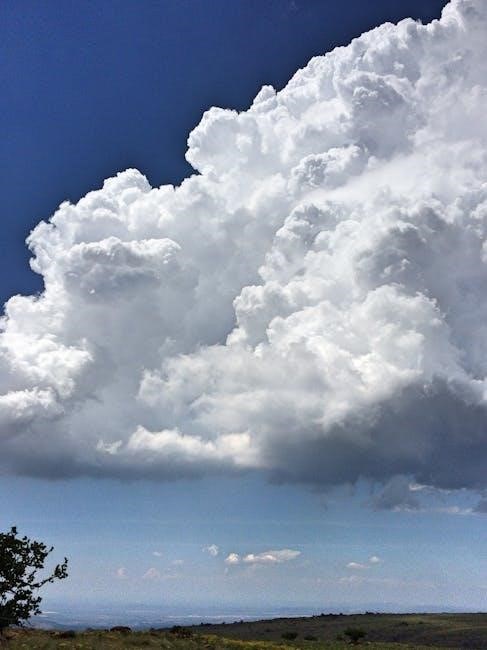
Air mass cooling, driven by lifting mechanisms like orographic, frontal, and convectional forces, initiates formación de nubes y lluvias, alongside condensation nuclei.
Cooling of Air Masses
The sun’s energy heats Earth’s surface unevenly, with lower altitudes warming faster. This warming extends to the air above, causing it to expand and become less dense. As the air expands, it rises, and this upward movement leads to cooling. This cooling process is fundamental to formación de nubes y lluvias, as cooler air holds less moisture. Consequently, water vapor begins to condense, initiating cloud development. The rate of cooling is critical, influencing the type of cloud formed and the potential for precipitation.
Adiabatic Cooling and Lifting Mechanisms
As air masses ascend, they experience adiabatic cooling – cooling due to expansion, not heat loss. Several mechanisms drive this lifting: orographic (over mountains), frontal (where air masses meet), and convectional (due to surface heating). These processes, central to formación de nubes y lluvias, force air upwards. The cooling air reaches its dew point, causing condensation. Understanding these lifting mechanisms is vital for predicting cloud formation and subsequent rainfall patterns, especially considering regional geographical features.
Orographic Lifting
Orographic lifting occurs when air is forced to rise over mountainous terrain. As the air ascends, it cools adiabatically, leading to condensation and cloud formation. This is a significant contributor to formación de nubes y lluvias, particularly on the windward side of mountains. The resulting precipitation diminishes as the air descends on the leeward side, creating a rain shadow effect. This process highlights the influence of geographical features on regional rainfall distribution.
Frontal Lifting
Frontal lifting happens when warmer, less dense air is forced to rise over cooler, denser air masses. This occurs at weather fronts – boundaries between different air masses. As the warm air ascends, it cools and condenses, fostering formación de nubes y lluvias. The type of front (cold, warm, occluded, stationary) dictates the intensity and duration of the resulting precipitation. This mechanism is fundamental to large-scale weather systems.
Convectional Lifting
Convectional lifting arises from uneven surface heating. The sun warms the Earth’s surface, and this heat transfers to the air above, causing it to become less dense and rise. As this warm, moist air ascends, it cools, leading to condensation and formación de nubes y lluvias. This process frequently results in localized, often intense, showers or thunderstorms, particularly during warmer months.
Role of Condensation Nuclei
Condensation doesn’t occur spontaneously; it requires tiny particles called condensation nuclei. These microscopic aerosols – dust, pollen, salt – provide surfaces for water vapor to condense upon, facilitating formación de nubes y lluvias. Without these nuclei, significantly higher levels of supersaturation would be needed. Their presence dramatically lowers the energy barrier for droplet formation, accelerating the cloud development process.
Cloud Types and Their Characteristics
Diverse cloud formations—high, mid-level, low, and vertical—are key to formación de nubes y lluvias, each developing under specific atmospheric conditions and exhibiting unique traits.
High Clouds (Cirrus, Cirrocumulus, Cirrostratus)
These clouds, forming at altitudes above 6,000 meters, are primarily composed of ice crystals due to the cold temperatures. Cirrus clouds appear as delicate, wispy strands, often indicating approaching weather changes. Cirrocumulus present as small, white patches, resembling ripples, while Cirrostratus form thin, sheet-like veils that can create halos around the sun or moon. Their formation is linked to atmospheric lifting and the availability of moisture at these high levels, contributing to the broader cycle of formación de nubes y lluvias.
Mid-Level Clouds (Altocumulus, Altostratus)
Found between 2,000 and 6,000 meters, mid-level clouds are composed of water droplets and ice crystals. Altocumulus clouds appear as grayish-white patches or layers, often in sheets or rounded masses. Altostratus clouds are gray or bluish-gray sheets covering the entire sky, sometimes allowing a dimly visible sun. These clouds form through lifting processes and contribute to the atmospheric moisture crucial for formación de nubes y lluvias, often preceding larger weather systems.
Low Clouds (Stratus, Stratocumulus, Nimbostratus)
Existing below 2,000 meters, low clouds significantly impact daily weather. Stratus clouds are gray, uniform sheets resembling fog that doesn’t reach the ground. Stratocumulus appear as rounded masses or rolls, often covering the entire sky. Nimbostratus are dark, gray, rain-producing clouds. These formations are key to formación de nubes y lluvias, developing from stable air and often bringing prolonged, light precipitation.
Vertical Clouds (Cumulus, Cumulonimbus)
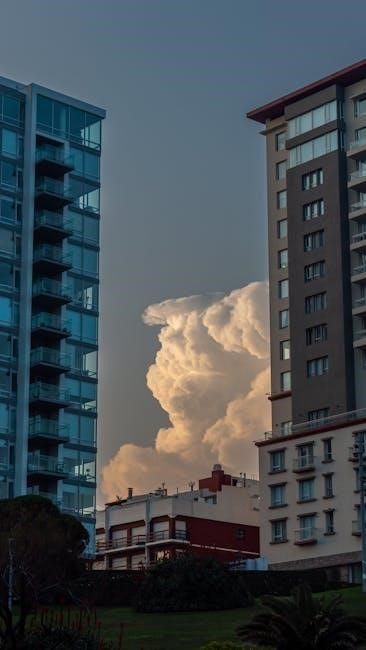
Characterized by significant vertical development, these clouds span multiple atmospheric levels. Cumulus clouds are puffy, white, and often have flat bases, forming through convection. Cumulonimbus are towering giants, associated with heavy rainfall, thunderstorms, and even hail – crucial in formación de nubes y lluvias. Their growth relies on rising air currents, and they can extend throughout the troposphere, impacting weather dramatically.
Rainfall Mechanisms
Precipitation occurs via the collision-coalescence process or the Bergeron process, where water droplets or ice crystals grow and eventually fall.
Collision-Coalescence Process
This process dominates in warmer clouds, where water droplets collide and merge into larger drops; As droplets ascend and descend within the cloud, they encounter supercooled water, increasing their size. The larger the droplet, and the longer it remains within the cloud, the greater its potential to become rainfall. A single droplet can grow significantly with sufficient liquid water content, eventually overcoming updraft forces and falling to the ground as rain. This mechanism relies on droplet interactions, not ice formation.
Bergeron Process (Ice-Crystal Process)
The Bergeron process, vital in colder clouds, involves ice crystals growing at the expense of supercooled water droplets. Even a small number of ice crystals – as few as one per liter – can trigger substantial precipitation. If temperatures remain below freezing, precipitation reaches the ground as snow, hail, or ice. Conversely, melting during descent results in rainfall. This process efficiently extracts moisture, leading to significant precipitation events.

Cloud Seeding: An Artificial Influence
Artificial stimulation of rainfall, like the Mexican program using silver iodide, aims to enhance precipitation by providing condensation nuclei for cloud development.
Silver Iodide Cloud Seeding Techniques
Silver iodide’s crystalline structure closely resembles ice, making it an effective condensation nucleus. Dispersed into clouds – often via aircraft along flight routes, as seen in Zacatecas and Aguascalientes – it encourages ice crystal formation. Even a single crystal per liter can trigger significant precipitation. This process, known as the Bergeron process, is particularly effective in colder cloud environments, transforming supercooled water droplets into raindrops or snow, ultimately increasing rainfall amounts.
Cloud Seeding Programs in Mexico (Zacatecas & Aguascalientes)
Mexico’s cloud seeding program, implemented in the north-central region during the 2012 rainy season, utilized silver iodide dispersal via 46 defined flight routes. Weather stations in Zacatecas and Aguascalientes monitored the program’s impact, focusing on areas influenced by these routes (Figure 1). The goal was to induce rainfall, leveraging the principle of providing condensation nuclei to enhance precipitation, addressing regional water resource needs.
Factors Affecting Rainfall
Rainfall is significantly influenced by temperature, humidity, and wind patterns, alongside geographical features like terrain, all impacting air lifting and condensation processes.
Temperature and Humidity
Temperature plays a vital role, as warmer air holds more moisture. The sun’s heating of Earth’s surface causes air to expand, become less dense, and rise – a key component of cloud and rainfall formation.
Humidity, the amount of water vapor present, directly impacts the potential for condensation. Higher humidity levels increase the likelihood of cloud development and subsequent precipitation.
These two factors work in tandem; warm, humid air is more buoyant and readily ascends, contributing to the processes described in formación de nubes y lluvias.
Wind Patterns and Atmospheric Circulation
Wind is instrumental in lifting air masses, a crucial step in formación de nubes y lluvias. Atmospheric circulation patterns dictate where and how this lifting occurs, influencing regional rainfall distribution.
Winds contribute to the transport of moisture-laden air, delivering water vapor to areas where condensation and precipitation can occur. Different lifting mechanisms, like orographic or frontal lifting, rely on wind patterns.
Understanding these patterns is essential for predicting cloud development and rainfall events, as detailed in studies of cloud seeding programs.
Geographical Features (Relief)
Topographical features, specifically relief, significantly impact formación de nubes y lluvias through orographic lifting. As air masses encounter mountains, they are forced to ascend, cooling and condensing moisture into clouds.
This process leads to increased precipitation on the windward side of mountains, while the leeward side often experiences a rain shadow effect. The terrain influences wind patterns and atmospheric circulation.
Studies analyzing cloud seeding programs in regions with varied relief demonstrate this relationship, highlighting the importance of geography.

Measuring Rainfall
Rainfall is quantified using rain gauges and METAR data from weather stations, like Melilla in Uruguay, providing current and historical precipitation insights.
Rain Gauges and Their Types
Accurate rainfall measurement relies on various rain gauge technologies. Standard rain gauges collect precipitation in a cylindrical vessel, measured manually. Automated gauges utilize sensors to record rainfall amounts continuously, transmitting data for real-time monitoring. These instruments are strategically placed within meteorological networks, including those supporting cloud seeding programs in regions like Zacatecas and Aguascalientes, Mexico. Data from these gauges, alongside METAR reports, are vital for understanding precipitation patterns and evaluating the effectiveness of weather modification efforts, providing crucial insights into formación de nubes y lluvias.
METAR Data and Weather Stations
Meteorological Aviation Routine Weather Reports (METAR) provide current surface observations, including precipitation, crucial for monitoring formación de nubes y lluvias. Weather stations, like the one at Melilla in Uruguay, collect this data. These stations, alongside those in Zacatecas and Aguascalientes, contribute to a network assessing atmospheric conditions. Analyzing METAR data reveals temperature, humidity, and wind patterns, informing cloud development and rainfall predictions. This information is vital for both routine forecasting and evaluating cloud seeding program impacts.
The Relationship Between Cloud Formation and Wind
Wind plays a key role in lifting air, a fundamental process in formación de nubes y lluvias, influencing cloud development and precipitation patterns significantly.
Wind’s Role in Lifting Air
As the sun heats the Earth’s surface, warmer air rises – a core component of formación de nubes y lluvias. This process, driven by temperature differences, creates upward air movement. Wind patterns are intrinsically linked to this lifting action, forcing air masses to ascend, cool, and condense. Different lifting mechanisms, like orographic, frontal, and convectional lifting, all rely on wind to initiate cloud formation. The upward movement is crucial for water vapor to reach altitudes where condensation nuclei facilitate droplet formation, ultimately leading to precipitation.
Formation of Winds and Their Impact on Cloud Development
Winds originate from uneven solar heating, creating pressure differences across the Earth’s surface – a key element in formación de nubes y lluvias. This drives air movement, influencing cloud development by providing the necessary lift for air masses. The resulting ascent cools the air, promoting condensation and cloud formation. Wind’s impact varies; orographic lifting occurs when air encounters terrain, while frontal systems create widespread cloudiness. Understanding these wind-driven processes is vital for predicting precipitation patterns.

Cloud Development and Precipitation in Uruguay
Current conditions at Melilla station, Uruguay, alongside historical METAR data, reveal insights into local formación de nubes y lluvias and precipitation events.
Current Conditions at Melilla Station
Melilla station’s surface data, reported as METAR, provides a real-time snapshot of atmospheric conditions crucial for understanding formación de nubes y lluvias. These observations detail present weather, including cloud cover and precipitation type. Analyzing these values alongside broader Uruguayan weather patterns helps determine the potential for cloud development. The station’s data reflects the immediate state of the atmosphere, indicating whether conditions are favorable for lifting mechanisms – orographic, frontal, or convective – that initiate cloud formation and subsequent rainfall. This information is vital for monitoring and forecasting.
Historical Weather Data (Last 12 Hours)
Examining the last 12 hours of weather data from Melilla station reveals trends in atmospheric conditions relevant to formación de nubes y lluvias. This includes changes in temperature, humidity, and wind patterns, all influencing air mass lifting and condensation. Tracking these shifts helps identify periods of increased instability or moisture transport. Observing precipitation amounts and types over this timeframe provides insight into recent rainfall events and the effectiveness of cloud formation processes. This historical context is essential for accurate weather analysis.
The Growth of Raindrops Within Clouds
Raindrop growth, as illustrated in Figure 3.13, depends on time spent within the cloud and liquid water content, ultimately resulting in rainfall.
Process of Raindrop Growth (Figure 3.13)
Within clouds, raindrops grow through a dynamic process of ascending and descending motions. The longer a water droplet remains within the cloud, the greater its potential to accumulate mass. This growth is directly proportional to the cloud’s liquid water content; higher concentrations facilitate larger droplet sizes.
A single ice crystal per liter can trigger significant precipitation via the Bergeron process. Ultimately, these droplets become heavy enough to overcome updrafts and descend as rain, hail, or snow, depending on atmospheric temperature profiles.
Factors Influencing Raindrop Size
Raindrop size isn’t uniform; it’s governed by several key factors. Prolonged residence time within the cloud allows droplets to collide and coalesce, increasing their volume. Crucially, the cloud’s liquid water content directly impacts potential size – richer clouds yield larger drops.
Temperature also plays a role; below freezing, crystals form, potentially becoming hail or snow. The Bergeron process demonstrates even minimal ice crystal presence can drive substantial precipitation.

Forms of Precipitation
Precipitation manifests as rain, snow, or hail, depending on atmospheric temperature profiles. If temperatures remain above freezing, raindrops fall; otherwise, ice forms.
Rain
Rain occurs when water droplets within clouds grow sufficiently large to overcome air resistance and descend to the Earth’s surface. These droplets increase in size through prolonged ascent and descent within the cloud, accumulating water as long as the cloud’s liquid water content is substantial.
The process hinges on the cloud becoming saturated, and a single crystal per liter can trigger significant precipitation via the Bergeron process. Ultimately, a water droplet will transform into a raindrop and fall.
Snow
Snow forms when water vapor in clouds transforms directly into ice crystals, bypassing the liquid phase, particularly at sub-zero temperatures. If the atmospheric temperature remains negative throughout the descent, these crystals reach the ground as snowflakes.
The Bergeron process plays a key role, demonstrating that even a single ice crystal per liter of air can initiate substantial snowfall, showcasing the efficiency of ice crystal growth in cold clouds.
Hail
Hail originates within cumulonimbus clouds exhibiting strong updrafts. Water droplets are carried upwards into freezing levels, accumulating layers of ice with each ascent and descent cycle.
If a droplet continues to experience sub-zero temperatures during its journey, it reaches the ground as a hailstone. The size of hailstones depends on the strength of updrafts and the amount of supercooled water available within the cloud.
Cloud and rainfall formation involve intricate interactions of temperature, humidity, and atmospheric lifting, culminating in precipitation as droplets descend.
Recap of Cloud Formation and Rainfall Processes
The journey from surface heating to precipitation begins with air expansion and ascent, driven by solar energy. This rising air cools, leading to condensation around nuclei, forming clouds. Lifting mechanisms – orographic, frontal, and convectional – further contribute to cloud development.
Raindrop growth occurs through collision-coalescence or the Bergeron process, depending on temperature. Ultimately, when clouds become saturated, water falls as rain, snow, or hail, completing the cycle. Understanding these interconnected processes is vital for predicting and managing water resources.
Future Research and Considerations
Continued investigation into the intricacies of formación de nubes y lluvias is essential. Further research should focus on refining precipitation prediction models, particularly concerning the impact of atmospheric circulation and geographical features.
Exploring the effectiveness of cloud seeding techniques, like silver iodide application in regions like Zacatecas and Aguascalientes, requires rigorous evaluation. Additionally, studying the influence of climate change on these processes is crucial for sustainable water management strategies.